

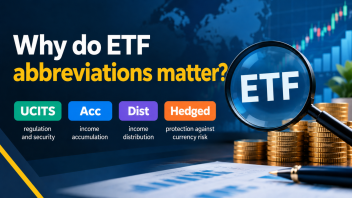
What fits into the name of a single ETF
An ETF (exchange traded fund) is an investment fund whose units are bought and sold on a stock exchange just like shares. With one purchase you get a small slice of hundreds or thousands of companies at once. Most ETFs track an index, a list of companies put together under fixed rules, for example the 500 largest US companies. The fund then buys the same companies in the same proportions the index holds them.
One of the best-known ETFs in the world will serve as our example. Its full name is iShares Core MSCI World UCITS ETF USD (Acc), and we cover it in detail in a separate article on iShares Core MSCI World UCITS. At first sight it’s a jumble of words. In fact every word tells you something, and together they add up to a short description of the fund.
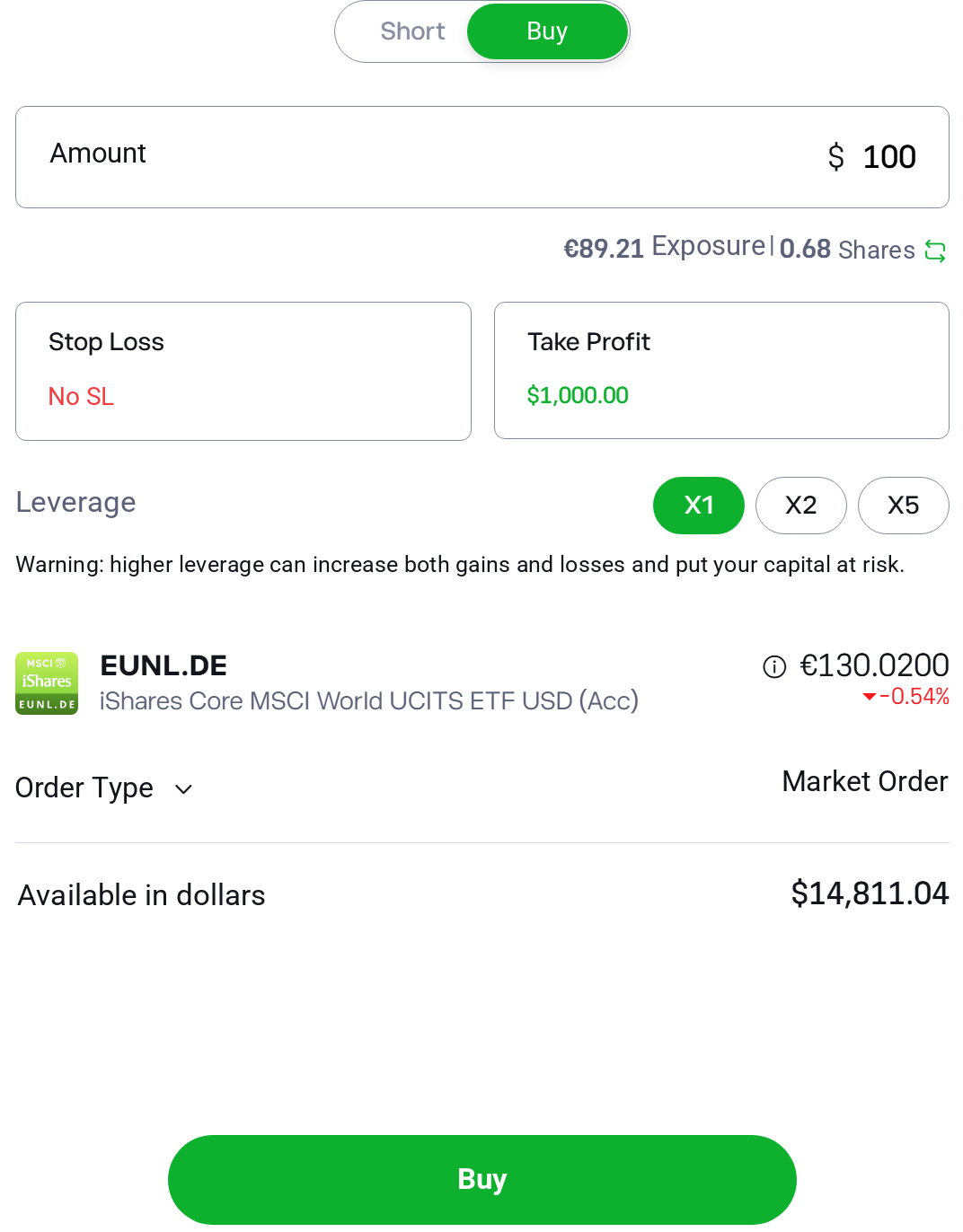
The image below shows an order for this ETF at the broker eToro. You’ll find the full name of the share class, including the (Acc) label, right under the ticker EUNL.DE.
Investing is risky. Invest responsibly.
The table below breaks down what each part of the name in the image stands for.
| Part of the name | What it means |
|---|---|
| iShares | the brand under which the US company BlackRock, the world’s largest asset manager, issues its funds |
| Core | a range of iShares funds with low annual fees that track broad indices and are meant as the base of a long-term portfolio; it’s a marketing name and has no effect on how the fund works |
| MSCI World | the index the fund tracks: roughly 1,250 large and mid-sized companies from 23 developed countries (1,249 exactly as at 30 September 2026) |
| UCITS | the fund meets European rules that protect ordinary private investors (more below) |
| ETF | a fund traded on a stock exchange |
| USD | the currency in which the fund calculates its value; it doesn’t mean you have to pay in dollars, and on some exchanges the same fund is bought in euros, for instance |
| (Acc) | the fund doesn’t pay you the dividends it receives from companies, it reinvests them itself |
A single fund is also often sold in several versions. The technical term is share class, and each one is bought separately, under its own name and at its own price. Every share class of a fund invests in exactly the same shares. They differ only in a few rules, mainly whether the fund sends you dividends and whether it shields you from exchange rate moves.
To be specific: you can buy iShares Core MSCI World as iShares Core MSCI World UCITS ETF USD (Acc), which reinvests dividends, or as iShares Core MSCI World UCITS ETF EUR Hedged (Dist), which pays them out and protects against moves in the dollar against the euro. The companies inside are the same. The result in your account won’t be.
Personally, I only pick funds labelled (Acc), because I don’t want to deal with reinvesting dividends by hand. It saves me a fair amount of time. In general I try to stay away from dividend stocks altogether.
These are exactly the differences the letters at the end of the name give away. There’s no common standard for writing them, though. Xtrackers, run by the German company DWS, uses 1C and 1D instead of Acc and Dist, where C marks a class that reinvests dividends and D one that pays them out. Vanguard puts the whole word at the end, as in Vanguard FTSE All-World UCITS ETF (USD) Accumulating. We can’t let this pass without saying that for anyone who opens funds from three different managers side by side it’s needless confusion, and a single format would spare beginners plenty of mistakes.
Each share class has its own ISIN, a twelve-character code that no other security in the world shares and that lets you find the fund at any broker with no risk of mixing it up.
UCITS: European protection for your money in a fund
UCITS stands for Undertakings for Collective Investment in Transferable Securities, a European directive. Put simply, these are the rules for investment funds that may be offered freely to ordinary private investors across the EU, meaning people investing their own savings rather than banks or insurers. The first version of the directive dates from 1985, and the one in force today is known as UCITS V. The UK carried the same rules into its own law after Brexit, and Irish or Luxembourg UCITS funds are sold to UK retail investors as recognised overseas funds.
A fund with this label has to follow strict rules. Investors’ money and shares aren’t looked after by the fund manager itself but by an independent bank (the depositary), which keeps them apart from the manager’s own assets. If the manager went bust, the shares in the fund would still belong to investors and its creditors couldn’t touch them.
The directive also polices how the money is spread, so the fund doesn’t rest on a single company. As a general rule a fund may put no more than 10% of its assets into the shares or bonds of one company, and all holdings above 5% together may not exceed 40%. Index funds get a looser limit, because they have to follow an index in which one large company can weigh more.
For UK investors UCITS has one more practical consequence, and it usually catches beginners out. US ETFs such as SPDR S&P 500 ETF Trust with the ticker SPY or Vanguard S&P 500 ETF with the ticker VOO (a ticker is the short code a fund trades under on an exchange) can’t be bought by a private investor through a UK broker. Since 1 January 2018 the PRIIPs rules have allowed a broker to sell such a product to a retail investor only with a mandatory KID, and US funds don’t publish one. From 6 April 2026 the UK is replacing PRIIPs with its own rules for consumer composite investments (CCI), but a US fund would still need FCA recognition before it could be sold to retail investors, and so far none has it.
The only exception is a client the broker classes as professional, a status that depends on things like portfolio size, the number of trades or experience working in finance.
A short mandatory summary of a fund, no longer than three A4 pages, which every fund offered to private investors in the EU must have. It tells you what the fund invests in, how risky it is on a scale of 1 to 7, what it costs and how it might fare in four model scenarios ranging from a stress scenario to a favourable market. In the UK the KID is being replaced by a CCI product summary, with a deadline in June 2027. Brokers usually show it right on the ETF’s detail page.
I have to admit I see the protection UCITS gives as one of the best pieces of European investor regulation.
What we get out of it is that there’s little point hunting for US ETFs. European versions of the popular indices exist and cost no more than the US originals; iShares Core S&P 500 UCITS ETF, for example, charges an annual fee of 0.07%. At a UK broker you’ll find the UCITS label on almost every ETF, so you don’t have to watch for it yourself. And that’s exactly why it’s worth knowing: it explains why well-known US ETFs are missing from the list and why your money in a fund can’t vanish along with the manager.
Acc or Dist: where the dividends go
A dividend is the part of its profit a company pays out to its shareholders. The fund owns shares in the companies in the index, so it’s the fund that receives the dividends. What happens to them next is decided by the Acc or Dist label.
Acc (accumulating) doesn’t pay dividends out. The fund immediately uses them to buy more shares, so the price of each ETF unit you own grows faster. Nothing lands in your account.
Dist (distributing) sends dividends to investors, depending on the fund once a year, twice a year, quarterly or occasionally even monthly. The money arrives in your broker account and you decide whether to spend it or invest it again.
Instead of Dist you’ll sometimes see Inc (income), and instead of Acc you may find Cap or the letter C.
Same thing.
| Acc (accumulating) | Dist (distributing) | |
|---|---|---|
| What happens to dividends | the fund buys more shares with them | the fund sends them to you |
| Money in your account | none | regularly, on the fund’s calendar |
| Compounding (returns earning further returns) | happens on its own | only if you reinvest the dividends yourself |
| Cost of reinvesting | none | the broker’s fee on every new purchase |
| Example | iShares Core MSCI World UCITS ETF USD (Acc), ticker SWDA | iShares Core S&P 500 UCITS ETF USD (Dist), ticker IUSA |
For most people who invest regularly and for a long time, Acc comes out ahead in our view. How the two classes differ for tax purposes is covered in a separate chapter on tax. But the distributing class has its place. It suits anyone who wants the investment to top up their income, typically in retirement, because a regular dividend is then more practical than selling a slice of the investment every month.
Dist does worse for an investor who reinvests the dividends straight away anyway. Every purchase costs them the broker’s fee, and if the broker can’t buy a fraction of a unit, the leftover cash sits idle in the account until the next payout. This is where the distributing class didn’t convince us.
Hedged: currency protection that comes at a price
Most global ETFs hold shares in US companies priced in dollars. You, though, count in pounds. When the dollar weakens against the pound, your investment is worth less in pounds even if share prices haven’t moved at all.
Hedged means the fund protects itself against this effect. The currency the class is hedged into always sits next to the word Hedged, for example EUR Hedged or GBP Hedged. The fund signs contracts with banks that fix in advance the rate at which it will swap dollars into that currency a month later, and it rolls them over every month. If the dollar then weakens by 5% against the euro, the unhedged class priced in euros loses roughly 5% on the currency, while the EUR Hedged class hardly registers the move.
There’s a catch.
Hedging costs money, and the cost shows up twice. First in a higher annual fee: the hedged class iShares Core MSCI World UCITS ETF EUR Hedged (Dist) charges 0.30% a year, while SWDA, the unhedged class of the same fund, charges 0.20%. The older stand-alone fund iShares MSCI World EUR Hedged UCITS ETF (Acc), ticker IWDE, takes as much as 0.55%. Second in the price of the bank contracts themselves, which isn’t part of the fund’s fee and depends on the gap between interest rates in the two currencies. When US rates are higher than those of the hedged currency, an investor in the hedged class pays roughly that gap on top every year.
For an investor in pounds, EUR Hedged is the wrong tool. It only protects against the dollar moving against the euro and leaves the exchange rate between the pound and the euro wide open. Sterling, unlike many smaller currencies, has hedged classes of its own: the same fund trades as iShares Core MSCI World UCITS ETF GBP Hedged (Dist), ticker IWDG, also for 0.30% a year.
The way it looks to us is that for an equity ETF held for ten years or more, Hedged is mostly an unnecessary cost. Currency swings tend to partly even out over long periods, but the fee comes off every single year and its effect adds up. For an equity portfolio in pounds, this class didn’t convince us.
Imagine £10,000 invested for 20 years with shares returning 7% a year before fees. The unhedged class with a 0.20% fee would end up at roughly £37,300, the hedged class at 0.30% at roughly £36,600 and the fund charging 0.55% at roughly £34,900. The gaps of around £700 and £2,400 come from the higher fee alone, and the cost of the bank contracts isn’t even included. We picked the 7% return purely for the calculation; it isn’t a forecast.
So when does Hedged make sense? For bond ETFs, where the annual return is low and a currency move of a few percent can wipe it out entirely. And where you know you’ll need the money in pounds within a few years, in a class hedged to sterling.
Other abbreviations you’ll come across in ETF names
UCITS, Acc, Dist and Hedged are the ones that matter most. Fund names and factsheets carry plenty of others, though, and some of them affect the result more than their modest appearance would suggest.
| Abbreviation | What it means | What it means for you |
|---|---|---|
| TER | Total Expense Ratio, the fund’s total annual fee as a percentage | the fund takes it from investors’ money bit by bit through the year; you won’t see it on a statement, it shows up as a lower unit price |
| IE / LU | the country where the fund is set up (its domicile): IE is Ireland, LU Luxembourg; the first two letters of the ISIN tell you which | it affects the fund’s return, see the chapter on tax |
| Physical | the fund really owns the shares of the companies in the index | the fund’s overview shows exactly what it holds |
| Swap / Synthetic | the fund doesn’t own the index shares; a bank pays it the index return under a contract (a swap) | the risk that the bank fails to pay; UCITS caps it at 10% of the fund’s assets |
| Sampling | the fund doesn’t buy every company in the index, only a selected sample that behaves in a similar way | the result can drift further from the index than with a fund that holds everything |
| ESG / SRI | the fund leaves out companies that fail rules on protecting the environment and doing business responsibly, such as makers of weapons or tobacco | different companies in the portfolio, and therefore a different return from the standard index |
| Equal Weight | every company has the same share of the fund, Apple as much as the smallest company in the index | less weight on the biggest companies; the fund has to rebalance more often, and that costs money |
| Leveraged / 2x / Short | 2x: the fund aims to make twice the index’s move every day; Short: it makes money when the index falls | over longer periods the result strays a long way from twice the index; unsuitable for holding long term |
| ETC / ETN | a security that tracks the price of, say, gold or oil; legally it’s a debt of the issuer, not a fund | it also depends on whether the issuer meets its obligations; UCITS rules don’t apply to them |
A short detour into tickers, because they can confuse people too. The same fund has a different ticker on every exchange: the SWDA mentioned earlier, listed in London, trades as EUNL on Germany’s Xetra and then looks like two separate products in a broker’s app. Only the ISIN pairs them reliably, for this fund IE00B4L5Y983. But back to the point.
TER and tracking difference
TER is the first thing we check on any fund. For large ETFs tracking broad indices it now sits at about 0.20% a year or less: Xtrackers MSCI World UCITS ETF 1C charges 0.12%, for example, and the cheapest S&P 500 funds, such as SPDR S&P 500 UCITS ETF (Acc), just 0.03%. On a £10,000 investment, a 0.12% fee comes to around £12 a year.
Tracking difference gives a sharper picture: how far the fund actually fell behind the index over the past year, or how far it beat it. A fund can lend the shares it holds to other institutions for a fee and cover part of its costs that way. Equally, it can lag the index by more than its TER would suggest.
Physical or synthetic replication
Physical replication means the fund really holds the index shares. A synthetic fund labelled Swap holds other securities, and a bank pays it, under a contract, exactly what the index earned.
Let us add a small note here. Swap sounds riskier than it really is, because UCITS rules cap what a fund can have at stake with any one bank under such a contract at 10% of its assets. The tax advantage of synthetic funds on the S&P 500 is set out in the chapter on tax.
Leverage and short
Leveraged, 2x, 3x or Short in the name means a leveraged fund that multiplies the index’s daily moves, or a fund that profits when it falls. These funds reset every day. If an index falls 10% one day and rises 10% the next, it ends at 99% of where it started, but a 2x fund loses 20%, then gains 20% and ends at 96%. They aren’t built for long-term investing.
Tax on ETF investments in the UK
This chapter is a general overview, not tax advice. Tax rules change and the way they’re applied can vary from case to case. Check your own situation with a tax adviser or directly with HMRC. We accept no liability for decisions made on the basis of this information.
Some abbreviations in an ETF’s name also decide when and how much tax you pay. That’s why everything to do with tax sits in this one place.
Acc or Dist
| Acc (accumulating) | Dist (distributing) | |
|---|---|---|
| Taxation in the UK | income the fund keeps is taxed every year as excess reportable income | dividends are taxed in the tax year they’re paid |
The account often matters more than the share class. Dividends and gains inside a Stocks and Shares ISA are tax-free whichever class you hold, and in the 2026/27 tax year you can put up to £20,000 into ISAs. A pension (SIPP) doesn’t tax income or gains while the money stays inside it either; withdrawals are taxed later under pension rules.
Outside these wrappers, dividends above the £500 dividend allowance are taxed from 6 April 2026 at 10.75% for basic rate taxpayers, 35.75% at the higher rate and 39.35% at the additional rate. Gains on a sale above the £3,000 annual exempt amount are subject to capital gains tax at 18% or 24%, depending on your income band.
Irish and Luxembourg ETFs count as offshore funds for UK tax, and this is where Acc behaves differently. If the fund has reporting fund status, the income an accumulating class keeps is reported every year as excess reportable income and you pay tax on it as if it had been paid out. That same amount is then added to your purchase cost, so it isn’t taxed a second time when you sell. Without reporting status, the whole gain on a sale is taxed as income rather than as a capital gain. HMRC publishes a list of reporting funds, and we haven’t checked every share class named in this article against it.
Outside an ISA, then, Acc doesn’t postpone tax on dividends: the Dist investor pays on what was paid out, the Acc investor on what was reported, and both do so every year. Acc tends to mean more paperwork, because the figure never reaches your account and you have to look it up in the fund’s report. If you plan to move from Acc to Dist as retirement approaches, selling the Acc units outside an ISA is a disposal for capital gains tax, so always check the tax impact of such a switch with a tax adviser.
Domicile: Ireland or Luxembourg
For funds holding US shares, the country where the fund is set up has a measurable effect. The US withholds tax on dividends before the fund even receives them. Ireland has a double taxation treaty with the US, so an Irish fund pays 15% on US dividends. A Luxembourg fund in a similar position usually pays 30%. You won’t see the difference on any statement, only in a slightly lower return from the fund.
Synthetic funds and US tax
On the S&P 500, a synthetic fund labelled Swap has a tax advantage. It doesn’t own US shares, so US tax on dividends doesn’t touch it. Invesco S&P 500 UCITS ETF works in exactly this way.
How to read an ETF name in practice
- Acc or Dist? It comes down to whether you want dividends paid into your account.
- Hedged only for a specific reason.
- TER and tracking difference are worth comparing only between funds on the same index, otherwise you’re comparing apples with oranges.
- The ISIN shows the fund’s country of domicile and the exact share class.
My own impression is that most mistakes happen when people buy by ticker, or by the first search result in a broker’s app, where different classes of the same fund appear one under another with near-identical names. The ticker isn’t enough. Anyone who gets used to checking the full class name and its ISIN will avoid the vast majority of errors.
If you’re still deciding where to put your money, our guide how and what to invest in with ETFs gives a general introduction. Specific funds are compared in our overview of the best ETFs.
When you’re choosing between two classes of the same fund, open the KID for both. The full class name, including Acc or Dist, is right on the first page, and the costs section shows what that class really costs you.
Frequently asked questions
What does UCITS mean on an ETF?
That the fund meets European rules for funds aimed at ordinary private investors, including limits on how the money is spread and the duty to hand its assets to an independent bank for safekeeping.
Is an accumulating or a distributing ETF better?
It depends on what you want from the investment. If you’re saving for the long term and would reinvest the dividends anyway, the accumulating class does that for you, with no fees. The distributing class suits you if you want a regular income from the investment, for example in retirement. Some investors combine the two and gradually move from Acc to Dist as retirement gets closer. The tax differences between the two classes are summed up in the chapter on tax.
Can I buy US ETFs such as VOO or SPY?
No. As a private investor in the UK you can’t buy them as actual fund units through a UK broker, because no US fund is recognised for sale to UK retail investors. The same index is tracked by UCITS funds, for example iShares Core S&P 500 UCITS ETF.
Are ETFs labelled Hedged worth it?
For bonds and shorter horizons yes, but for shares held over many years we think hedging usually costs more than it brings.
What do 1C and 1D mean on Xtrackers funds?
1C is the class that reinvests dividends, 1D the one that pays them out.
How can I tell where a fund is domiciled?
From the first two letters of the ISIN. IE means Ireland, LU Luxembourg.