


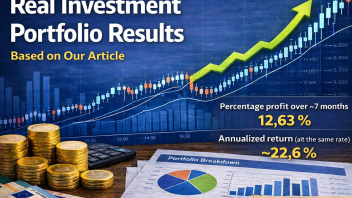
That is exactly what happened with one of our readers, who used a referral code during registration with XTB, requested bonus educational articles, and built a portfolio based on one of them. After just under seven months, she sent us screenshots from the platform. We are presenting her experience as an educational example, not as investment advice. Everything was done at her own risk.
How it started
We contacted her by email because she was the first person to request the bonus educational articles. During testing, I was pleased that she responded quickly and was positive in her approach. Her reply included a specific description and screenshots from the XTB mobile app.
Here is her experience in her own words.
How did you actually get into investing?
“I opened an account with XTB through your code and immediately requested those educational materials. But first I wanted to try trading on my own. I opened a few CFD positions blindly, just to see how the platform worked. After a few trades, I was down €5, and even though that is not a large amount, I decided not to trade CFDs for the time being. I did not want to sit there analysing charts. Then I used your article on selecting six ETFs and followed what was written in the text.”
A portfolio focused on markets outside the US
For context, our article “Exclusive Selection of 6 ETFs – a long-term investment with high potential” recommends a portfolio with minimal exposure to the US dollar. We work on the assumption that the dollar will weaken over the long term and that markets outside the US offer more stable growth potential.
For investors with an account held in euros, this is especially beneficial because it removes unnecessary currency risk. This is therefore educational material, not investment advice.
The reader built the portfolio exactly according to the article and invested €395 in it on 30 July 2025.
What happened afterwards? Did you follow it regularly?
“Honestly, not much. I am on maternity leave and do not have time to deal with charts every day. I checked the app from time to time. The portfolio as a whole was growing, with smaller fluctuations, so I had no reason to panic. What caught my attention was that one ETF went significantly into the red and is currently at -16%, while another rose sharply and is currently at +33%, and the rest grew gradually. The portfolio’s behaviour basically matched what the recommended strategy described.”
This is exactly how risk diversification works in practice. When one asset falls, others can offset it. What matters is the performance of the portfolio as a whole, not the individual components.
Real figures backed by screenshots from the XTB platform
As of 20 February 2026, the portfolio value had grown from €395 to €444.61. Let us break it down.
| Indicator | Value |
|---|---|
| Initial deposit (30/07/2025) | €395.00 |
| Current value (20/02/2026) | €444.61 |
| Total profit | €49.61 |
| Percentage gain over ~7 months | 12.63% |
The total profit is €49.61, or 12.63%. The period from the end of July 2025 to 20 February 2026 is roughly 6 months and 21 days. If we convert that pace to a full year, we get an annual return of about 22.6%. Of course, it is not that simple. Markets do not move in a straight line, and past performance is not a guarantee of similar results in the future. We plan to ask the reader regularly how the portfolio is doing, whether in one year, two years or 5 years. In this way, we will get a more accurate picture of its success.
Screenshots from the XTB mobile app show the start date and portfolio results
The screenshots show that the first ETF was purchased on 30/07/2025 at 9:04, with the other ETFs bought shortly afterwards. The ETF with the highest percentage return reached +33.42%, while the worst-performing ETF reached -16.01%. The other ETFs show percentage returns between 7.83% and 14.75%.
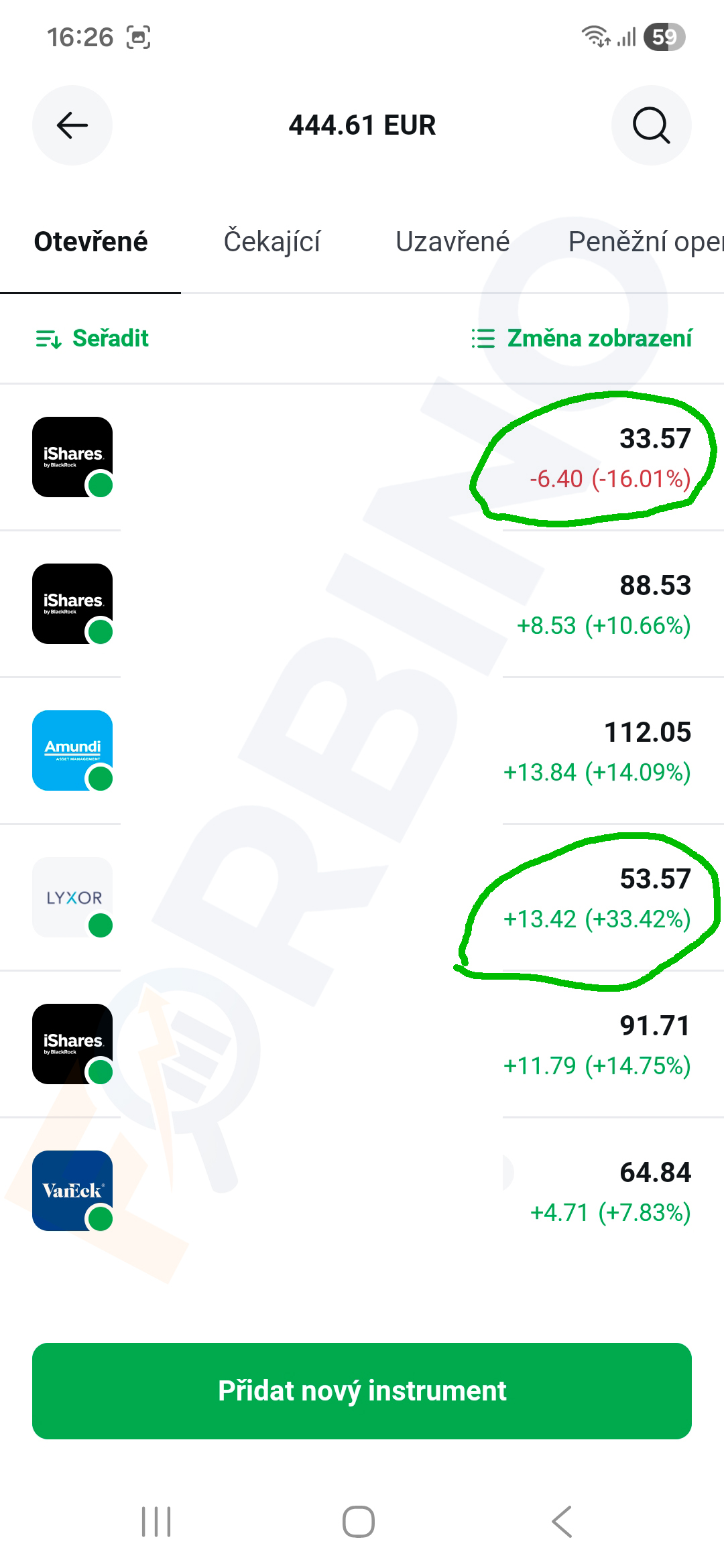
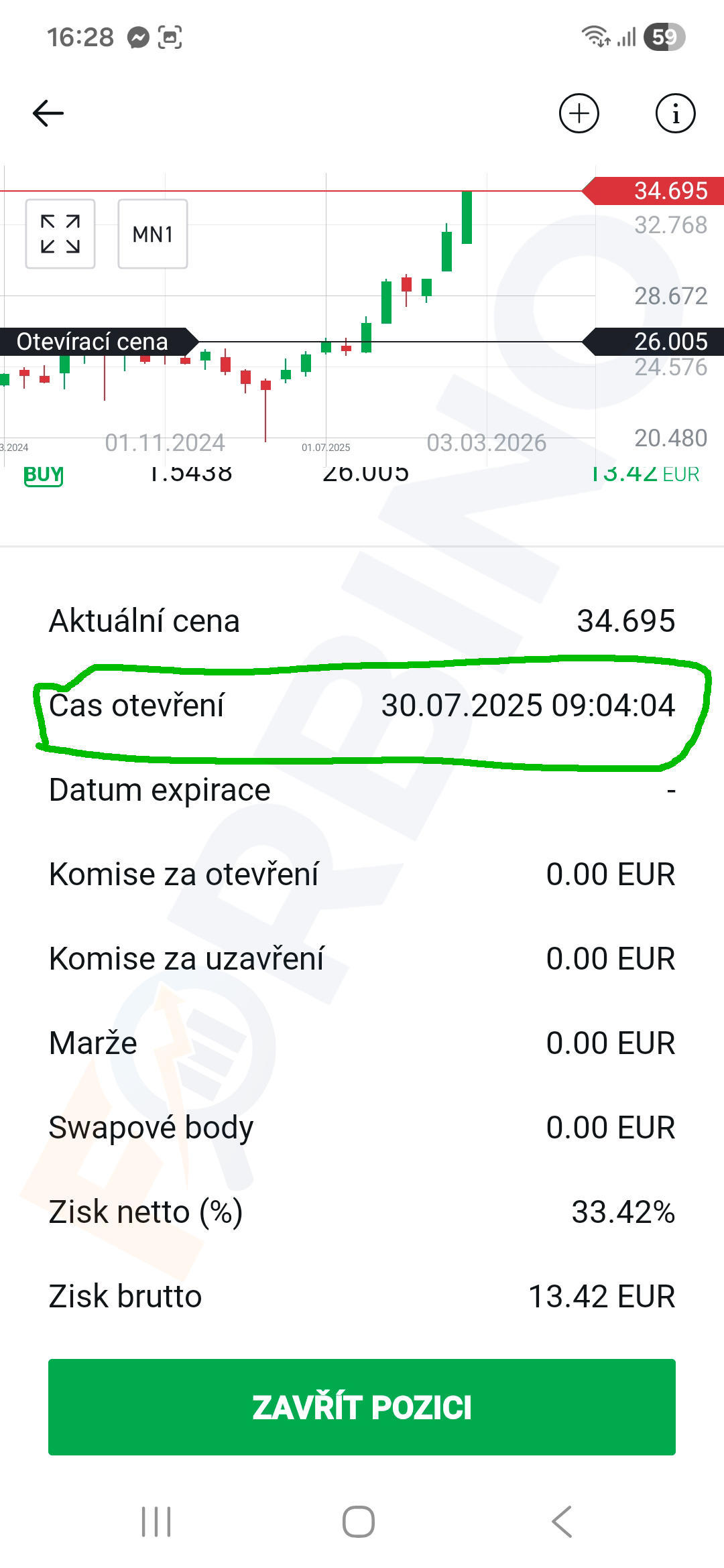
Note: The screenshots are in Czech because the lady is Czech, but the data is understandable in any language.
I must admit that 12.6% in just under seven months is a result that pleasantly surprised us. However, it is important to point out the risks here, namely that past performance is not a guarantee of the same or similar results in the future.
What next? Plans for the future
Will you change the portfolio in any way or add more to it?
“I definitely plan to invest more money. This has reassured me that it makes sense. I have not had much time to give it more attention, so I simply left the money there. Going forward, I believe it will develop well.”
And what about the CFDs you tried at the start? Do you plan to continue?
“Not really. I want to read another of your articles about commodity CFDs and forex. Since this made a profit for me without much effort, I am happy to read more materials as well. I also follow current market developments directly in the XTB app and in the media, as well as the uncertainty around the US economy, but mainly just for context. I might put a few euros into short-term speculation around the USD, but not as a source of income. ETFs remain the core.”
A similar approach, separating long-term investing from short-term speculation, is exactly what we explain in our educational materials. This is not a recommendation, only shared experience.
What to take away from this
We do not want this to sound like “just click and the money multiplies by itself”. That is not how it works. Markets can fall just as easily as they can rise, and 7 months is far too short a period to draw general conclusions from it.
What this experience does show, however, is something else. That even with a relatively small amount and without checking charts every day, it is possible to invest sensibly. That diversification across several ETFs works as it should. And that getting started does not have to be as difficult as many people imagine.
At the same time, it is only fair to add that the reader benefited from favourable timing. Markets outside the US performed well during this period. In a different period, the result could have looked different. We are attaching screenshots from the broker’s platform to all figures.
If you are interested in which ETFs the portfolio contains and how it was built, we send these materials to readers who open an account with XTB through our referral code.
FAQ
Why is the portfolio focused outside the US?
We work on the assumption of long-term dollar weakness and more stable growth in markets outside the United States. For investors with an account in euros, this also means minimal currency risk. This is an educational example, not a recommendation.
Is XTB a safe broker?
Yes. XTB is supervised by the FCA and has more than 2,000,000 clients worldwide. For transparency, we add that the owner of the Forbino website also trades with XTB and shares both positive and negative experiences with XTB in the review.
How much money do I need to start?
Our reader started with €395. With XTB, you can start with as little as €1, but for a meaningful portfolio we recommend at least several hundred euros.
Do I need to check the portfolio every day?
No. The aim of long-term ETF investing is rather passive growth. An occasional look at the overall performance is sufficient.