

LYNX Broker is an international online brokerage firm specialising in multi-asset trading and investment services. Founded in 2006, LYNX is headquartered in the Netherlands and operates across several regions worldwide. Notably, LYNX operates as an introducing broker of Interactive Brokers, meaning it combines Interactive Brokers’ infrastructure with its own localised services and support.
Lynx – Pros and Cons
Pros
- Massive Market Access – Provides access to over 150 markets covering almost every major global asset class.
- Institutional-Grade Tools – Features the LYNX+ and Trader Workstation (TWS) advanced platforms.
- Strong Regulation – Regulated by BaFin and AFM, which operate under the ESMA framework.
Cons
- Complex Platforms – Advanced tools may overwhelm inexperienced traders.
- Limited Payment Methods – Only bank transfer is available.
Basic Information
| Website | lynxbroker.com 74-89% of retail investor accounts lose money when trading CFDs with this provider. |
| Authorisation / Regulation | BaFin, AFM |
| Minimum Deposit | $0 (securities account), €2,000 (margin account) |
| CFD Leverage | 1:30 |
| Spreads | Variable, from 0.1 pips (commission-based pricing) |
| CFD Instruments | Indices, forex, metals, shares, energies |
| Real Assets | Stocks, forex, options, futures, bonds, mutual funds, ETFs, gold, cryptocurrencies, forecast contracts, hedge funds |
| Trading Platforms | LYNX+ Platform, Trader Workstation (TWS) |
| English Version | Yes |
| Demo Account | Yes |
| Mobile App | Yes |
| Deposits & Withdrawals | Bank Wire, SEPA |
| Extra Benefits | Direct market access via Interactive Brokers’ infrastructure |
Trading Platforms
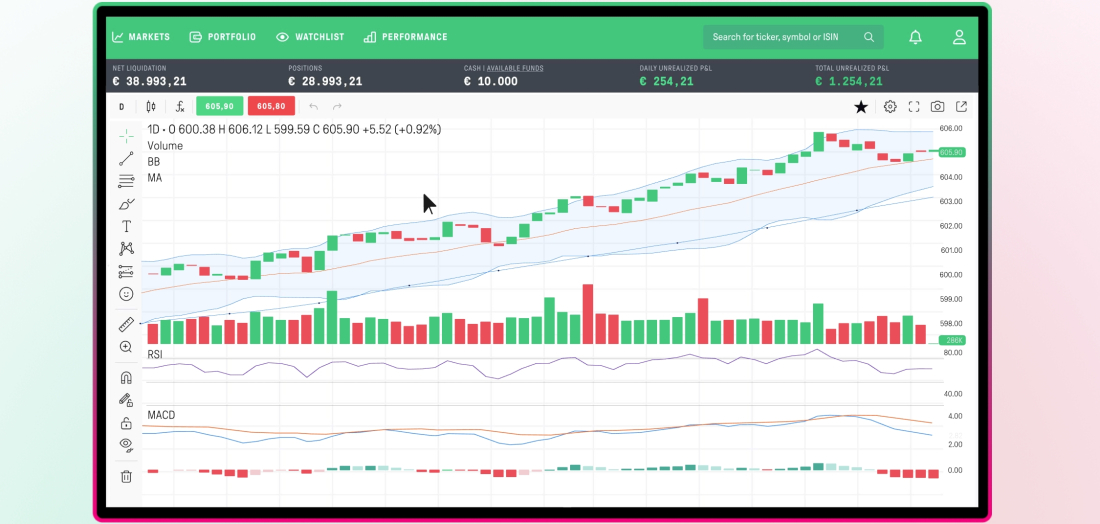
LYNX places a strong emphasis on professional trading technology. It leverages Interactive Brokers’ globally recognised infrastructure while adding its own proprietary interface, LYNX+. The LYNX+ platform is a modern trading solution designed to simplify trading for investors who prefer a cleaner interface. It offers advanced charting, portfolio analysis, integrated news, watchlists, and seamless order execution across various asset classes.
For advanced and professional traders, Trader Workstation (TWS) is the primary platform. TWS is a powerful platform offering advanced order types, algorithmic trading, risk management tools, options analytics, Level II market data, and multi-asset portfolio management. It supports highly customised workspaces and is widely regarded as one of the most comprehensive trading platforms available.
Trading Instruments Available
Lynx provides access to a vast universe of financial instruments through the Interactive Brokers network. This makes it one of the most comprehensive brokers for direct market access. Here is a breakdown of the assets available.
Real assets
- Forex – LYNX provides access to over 100 currency pairs, including major, minor, and exotic forex markets, all offered with institutional-grade pricing.
- Stocks and ETFs – Through LYNX, traders gain direct market access to shares and ETFs listed on more than 90 global exchanges, spanning the US, Europe, Asia, and emerging markets.
- Bonds – LYNX offers access to over 1 million bonds, including U.S. Treasuries, corporate bonds, and municipal bonds.
- Futures and Options – The broker supports trading in thousands of futures and options contracts across global exchanges, covering indices, commodities, and currencies for both hedging and speculative strategies.
- Commodities – LYNX allows traders to access a wide range of commodities, including energy products and agricultural goods, among others.
- Cryptocurrencies – LYNX supports the trading of major cryptocurrencies such as Bitcoin (BTC) and Ethereum (ETH), among others.
- ETFs – With LYNX, investors can access a broad range of Exchange-Traded Funds covering all major asset classes, investment strategies, and geographic regions.
CFDs
In addition to trading real assets, LYNX supports CFD trading on a variety of products, allowing traders to speculate on price movements without owning the underlying asset. Specifically, traders have access to CFDs on forex, shares, indices, metals, and energies.
LYNX Account Types and Fees
Lynx operates with a straightforward, professional pricing model. Pricing is commission-based, with fees varying by asset class, location of a trader, and exchange. There is no markup on spreads for many assets. As an example, major forex currency pairs feature spreads that start from as low as 0.1 pips plus the commission based on volume. Based on Interactive Broker’s fee structure, traders with a monthly trading volume equal to or less than $1 billion pay a commission of 0.20 basis points multiplied by the trade value.
There is no account opening, custody, or deposit fee, and one withdrawal per month is free. However, if your monthly trading commissions are below €5, LYNX applies a minimum activity fee to bring the total up to €5. Further, LYNX charges swap fees for leveraged positions held open overnight. The exact fee that applies varies depending on the asset class and the size of the position.
LYNX’s fee structure is designed with transparency in mind, particularly for active traders and investors who value institutional-style pricing. While we may not have covered the entire fee structure, traders can freely check the fees involved on the broker’s official website based on their location. Because pricing is commission-based, costs are generally lower for high-volume traders compared to brokers that build fees directly into spreads.
Corporate and Joint Accounts
LYNX offers joint and corporate investment accounts designed for clients who wish to trade and invest under shared or business ownership structures. These account types provide access to the same broad range of global markets and professional trading infrastructure that LYNX offers to individual clients.
A LYNX joint account is intended for two individuals who want to hold and manage investments together. Both account holders are registered owners of the account and typically have equal trading rights and responsibilities. This structure is commonly used by married couples or individuals with a mutual financial interest.
A LYNX corporate account is designed for legal entities such as companies, partnerships, or other registered organizations. Corporate accounts are often used for long-term investing, treasury management, speculative trading, or risk hedging. Because the account is opened in the name of a legal entity, additional documentation is required, including company registration details, ownership structure, and authorization of designated traders.
Both joint and corporate accounts at LYNX can usually be set up as cash or margin accounts. Cash accounts are suitable for straightforward investing in real assets while margin accounts are required for derivatives trading. Both types benefit from the full range of tools but involve more setup requirements compared to individual accounts.
Customer Support

Reliable customer support is essential for active trading. Customer support at LYNX is robust, particularly for European traders. The broker offers multilingual assistance through various channels. Primarily, clients can reach the support team via phone and email during local business hours, that is from 8:00 am to 10:00 pm from Mondays to Fridays. Further, the broker offers support through TeamViewer, where traders can give the support team remote access to their device. This allows the staff to walk customers through a given issue step by step. The broker is active on social media and provides extensive online resources, including FAQs and guides.
The Credibility
LYNX operates under strong European regulatory oversight, with supervision from the AFM of the Netherlands and the BaFin in Germany. Both of these organisations operate under the framework of the ESMA. Under ESMA regulations, LYNX adheres to leverage limits, transparency requirements, and strict capital adequacy standards. Client funds are held in segregated accounts, and investor protection schemes apply depending on the jurisdiction.
As an introducing broker of Interactive Brokers, LYNX benefits from one of the most established and financially robust trading infrastructures in the industry. Interactive Brokers is publicly listed and known for its strict risk management and capital adequacy standards.
Customer reviews are generally positive, particularly regarding execution quality, platform stability, and market access. Several of the broker’s entities are highly rated on Trustpilot with scores of 4.4, 4.7, and 4.9 stars out of 5. These are high ratings across the board, which is a good sign, to say the least. However, some criticism exists around platform complexity and the learning curve, especially for new traders.
Educational Resources
The core of LYNX’s education offering is its online knowledge hub, which includes written articles, practical guides, and platform tutorials. These materials explain key trading concepts, order types, and market mechanics while also helping traders navigate LYNX’s platforms, such as LYNX+ and Trader Workstation. The content balances theory and practice, making it useful for traders who already understand the basics and want to improve execution and decision-making.
LYNX places strong emphasis on webinars as part of its educational approach. The broker regularly hosts live webinars covering platform usage, market analysis, options trading, risk management, and broader macroeconomic topics. In addition to formal education, LYNX integrates learning into its trading environment through market insights and analytical resources. Traders gain access to market news, economic calendars, and commentary that support continuous learning.
How LYNX Compares With Competitors
Together with a colleague, we assessed LYNX in a head-to-head comparison with brokers such as Saxo Bank, XTB, eToro, and Pepperstone. LYNX positions itself in the professional and semi-professional segment.
Compared with Saxo Bank, LYNX offers deeper raw market access and lower costs for active traders, while Saxo excels in proprietary platform polish and banking services. Against XTB, LYNX provides a broader product range. However, XTB excels with its user-friendly in-house platform, xStation 5, and offers commission-free stock and ETF trading up to a monthly trading volume of €100,000, after which a 0.2% fee applies.
When compared to eToro, the differences are even more pronounced. LYNX offers more advanced trading platforms and a deeper collection of market products. However, it lacks copy trading services which eToro provides as a core feature.
Versus Pepperstone, LYNX focuses more on exchange-traded products and has a significantly larger collection of instruments. In contrast, Pepperstone is more CFD-oriented and supports a wider range of third-party trading platforms, including copy trading integrations.
Conclusion of Lynx Review
LYNX stands out as a sophisticated gateway for traders and investors seeking direct, institutional-grade access to global markets. By operating as an introducing broker of Interactive Brokers, LYNX combines one of the strongest global trading backends with robust infrastructure and strong regulations. Its access to more than 150 markets, extensive range of real assets and derivatives, and powerful platforms such as LYNX+ and Trader Workstation make it an attractive option.
That said, LYNX is not without its limitations. The advanced nature of its platforms can be challenging for trading newcomers. The lack of alternative payment methods beyond bank transfers may also deter some users. Further, the commission-based pricing may be too complex for some traders. The absence of copy trading and social investing features is also concerning for traders looking for guided or community-based strategies.
Overall, LYNX may be best suited for investors and traders who already have a solid understanding of financial markets and are seeking a professional-grade broker. Its competitors like Pepperstone, XTB, and eToro may provide a more intuitive trading experience. As with any brokerage, we encourage conducting due diligence and considering a demo account to ensure it fits your specific needs.

Our ratings are based on our editorial methodology and real testing. Find out how we test and rate brokers.
74-89% of retail investor accounts lose money when trading CFDs with this provider. You should consider whether you can afford to take the high risk of losing your money.