


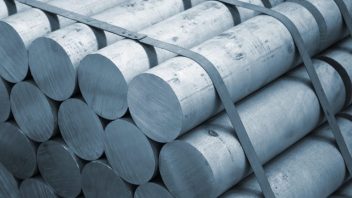
Aluminium is the second most widely used metal in the world after iron. A large proportion of the aluminium produced is used to make drinks cans.
| 1 t = 2,299.22 GBP | 1 t = 3,041.50 USD |
Chart showing the current aluminium price
Graph for last 7 days | 30 days | 3 months | 6 months | 1 year | 3 years | 5 years | 10 years
52% of retail investor accounts lose money when trading CFDs with this provider.
Price change
| 24h | -2.6 % | Week | -2.52 % |
| Month | -9.53 % | Year | 1.52 % |
Historical prices
| t | |
|---|---|
| Oct 08, 2026 | 2,299.22 GBP 3,041.50 USD |
| Oct 07, 2026 | 2,360.64 GBP 3,122.75 USD |
| Oct 06, 2026 | 2,377.46 GBP 3,145.00 USD |
| Oct 05, 2026 | 2,362.68 GBP 3,125.45 USD |
| Oct 02, 2026 | 2,341.55 GBP 3,097.50 USD |
| Oct 01, 2026 | 2,358.67 GBP 3,120.15 USD |
| Sep 30, 2026 | 2,396.62 GBP 3,170.35 USD |
| Sep 29, 2026 | 2,431.51 GBP 3,216.50 USD |
| Sep 28, 2026 | 2,457.97 GBP 3,251.50 USD |
| Sep 25, 2026 | 2,480.65 GBP 3,281.50 USD |
| Sep 24, 2026 | 2,461.37 GBP 3,256.00 USD |
| Sep 23, 2026 | 2,457.97 GBP 3,251.50 USD |
| Sep 22, 2026 | 2,465.45 GBP 3,261.40 USD |
| Sep 21, 2026 | 2,468.82 GBP 3,265.85 USD |
| Sep 18, 2026 | 2,491.99 GBP 3,296.50 USD |
| Sep 17, 2026 | 2,492.78 GBP 3,297.55 USD |
| Sep 16, 2026 | 2,474.22 GBP 3,273.00 USD |
| Sep 15, 2026 | 2,459.03 GBP 3,252.90 USD |
| Sep 14, 2026 | 2,456.83 GBP 3,250.00 USD |
| Sep 11, 2026 | 2,461.86 GBP 3,256.65 USD |
What aluminium is and how it is used
Aluminium, with the chemical symbol Al and the Latin name aluminium, is a lightweight metal and an excellent conductor. It is used in electronics manufacturing and the aerospace industry. It is grey and malleable. Aluminium occurs naturally in the form of compounds. As a result, extracting the pure metal is demanding both environmentally and economically.
Aluminium is used in many industries, particularly engineering, construction and automotive manufacturing. It is often used in alloys as a structural material, as well as to produce electronic components and packaging for food and drink.
You may be surprised to learn that cans account for approximately 40% of aluminium sales, while the automotive industry consumes only 24% of global production.
Global aluminium production
According to the latest available data, approximately 74 to 75 million tonnes of aluminium are produced worldwide each year. Production has been rising over the long term.
China produces by far the largest share of the world’s aluminium. In 2025, it produced a record of approximately 45 million tonnes, accounting for more than half of global output. This brought China up to the national production ceiling it had set itself. India follows with production of around 4.2 million tonnes, followed by Russia.
The long-term rise in production is particularly evident in China. Over two decades, it has grown from a minor player into the dominant producer that now sets the tone for the entire market.
Historical aluminium price trends
Reliable historical aluminium prices are available from approximately the beginning of the 1990s. The metal’s price has experienced substantial fluctuations. The largest movements occurred during financial crises, when the price fell sharply. By contrast, immediately after periods of crisis, at the start of the subsequent economic recovery, the price of this commodity rose.
One sharp price increase occurred between 2005 and 2008. During this period, the price climbed from a local low of around 1,500 USD to a peak of 2,800 USD per tonne of aluminium. This was followed by a steep fall to 1,150 USD in January 2009, when the US mortgage crisis was at its height.
In 2011, the price climbed to 2,400 USD per tonne, but aluminium did not reach the highs of the previous cycle. The price then declined gradually, with two local lows occurring in November 2015 and March 2020, both at around 1,200 USD.
This was followed by very rapid growth from the start of the coronavirus pandemic in spring 2020. In March 2022, aluminium reached record levels of 3,900 USD to 4,070 USD per tonne. This peak was driven by concerns about a metal shortage following the outbreak of war in Ukraine. A decline followed, with the price returning to around 2,100 USD in 2023. In 2024 and 2025, aluminium traded within a range of approximately 2,200 USD to 2,800 USD, before returning to the 3,200 USD level in 2026.
Future aluminium price outlook
At the time this article was updated in July 2026, the price of aluminium on the London Metal Exchange (LME) was around 3,180 USD per tonne, close to its highest level since 2022.
China’s production ceiling of 45 million tonnes is keeping the supply side on alert. Once China approaches this limit, further production growth stalls, which supports the price. Low inventories on the LME provide additional support.
Technical analysis suggests that if demand remains firm, the price could stay in the upper part of its range. Tense geopolitical conditions, such as those surrounding the Strait of Hormuz, also pose an upside risk to the price. This is not investment advice.
How to trade aluminium
Aluminium is traded in metric tonnes (1,000 kg). It is traded primarily on commodity exchanges, most commonly through futures. One example is the well-known CME exchange, where aluminium is traded. Futures are divided according to the commodity’s delivery date or month.
52% of retail investor accounts lose money when trading CFDs with this provider.
Retail investors can use the services of various brokers to speculate on the price of aluminium through CFDs, or contracts for difference. Like exchange-traded contracts, these instruments are traded in tonnes, meaning that the unit price is quoted per tonne of aluminium.
Unlike precious metals such as gold or silver, physical aluminium trading is not realistically accessible to retail investors. Some companies, however, may invest in aluminium on a large scale, albeit indirectly. These are often metal-processing or mining companies. Businesses can purchase the raw commodity and use it to manufacture a value-added product, such as a drinks can.
What affects the price of aluminium
As with other commodities, the price of aluminium rises when industrial demand is high and the supply outlook is uncertain. Supply is now heavily influenced by China’s production ceiling, which limits further growth in output.
Low exchange inventories and geopolitical risks also exert upward pressure on the price. Conversely, if mining and smelting companies were to increase production significantly, the price could stabilise and stop rising in the years ahead.