


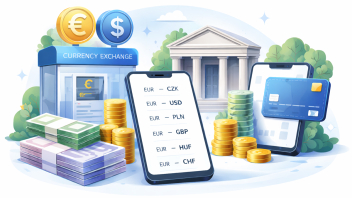
Exchange rates and fees are what matter
Every exchange is based on an exchange rate. But it is not always the rate you see in the news or on financial websites. Those usually show the interbank mid-market rate, meaning the price at which banks exchange currencies with each other. Retail customers almost never get that rate.
Exchange bureaus and banks use their own rates, which include their margin, the amount they add as profit.
Spread: the difference between buying and selling
On an exchange-rate board you usually see two figures:
- Buy – the rate at which the exchange bureau buys foreign currency from you,
- Sell – the rate at which it sells it to you.
The difference between these figures is called the spread. The larger it is, the higher the total cost of the exchange. Put simply, it is like buying goods in a supermarket. You want the retailer’s markup to be as low as possible.
Fees and commissions: watch the small print
Some exchange bureaus advertise an attractive rate, but then add a high fixed fee to the transaction. Others may offer a good rate only above a certain exchange amount.
When exchanging currency, it is essential to track the final total amount you will pay or receive. Do not rely only on the headline rate.
It is also important to confirm whether the quoted rate is final, or whether a commission or handling fee will be added, which would increase the total cost of the transaction. Finally, make sure the provider uses a clear and complete rate sheet that transparently separates buy and sell rates, so you have everything you need to make a fair decision.
Where exchanges usually have the lowest total cost
Banks are a safe option for currency exchange with clear terms. Even though their rates are often less competitive than those offered by specialist exchange bureaus, their strength is transparency. Today, however, banks face strong competition from fintech platforms such as XTB eWallet and Revolut. Their main advantage is that you often do not need physical cash at all. You exchange money directly in the app at a better rate and then pay by card (physical or virtual). That is not only more convenient, it is usually cheaper than handling banknotes. These apps also allow cash withdrawals from cash machines.
Specialist exchange bureaus outside tourist areas
Good exchange bureaus can offer very competitive rates, often better than banks. The key is to pay attention to location, because in busy tourist zones such as central London or at the airport, rates are often significantly worse for customers. Outside these high-traffic areas, you can usually find much more competitive and fair offers.
Withdrawing cash abroad
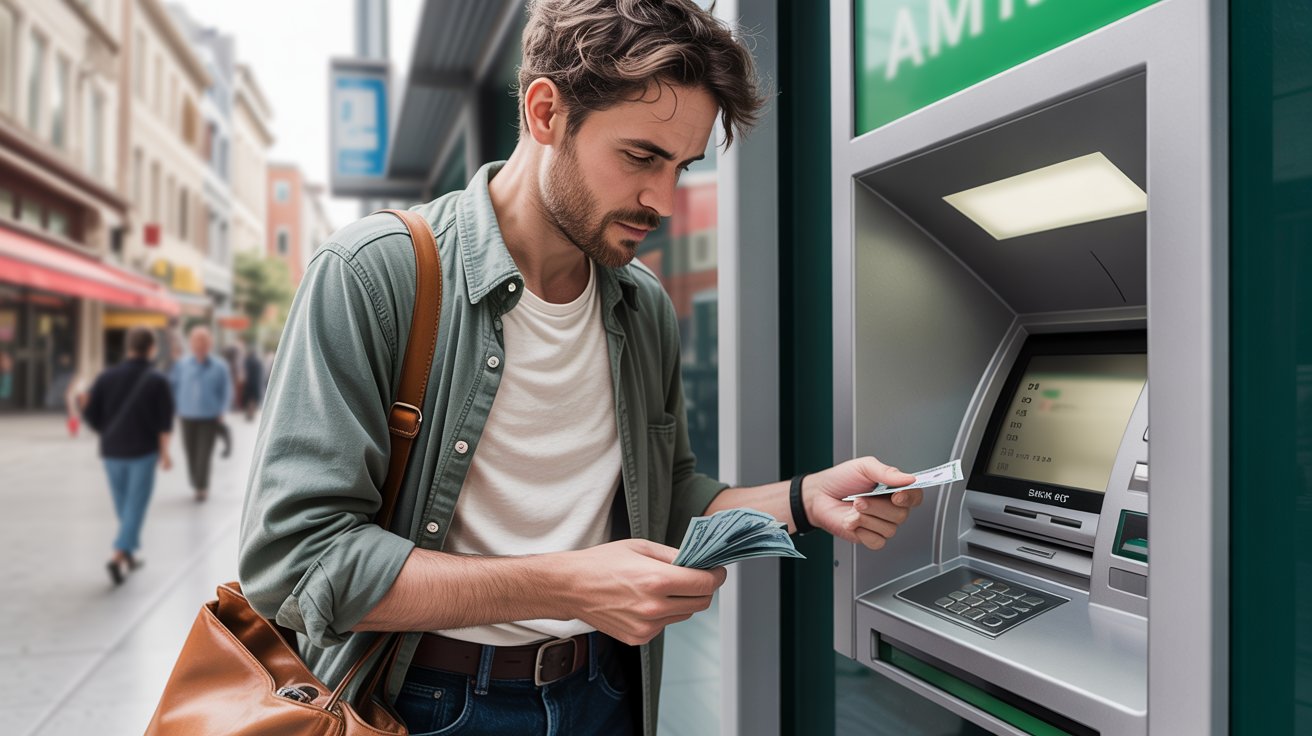
Banks are usually a stable and safe option for exchanging currencies. They have clear terms and typically do not have surprise fees. Even if their rates may be slightly worse compared to the lowest-cost offers from specialist exchange bureaus, their main advantage is fairness and transparency.
The downside can be less flexibility or limited opening hours. Increasingly, banks are being supplemented or replaced by modern digital services such as Revolut or XTB, which allow you to exchange directly in a mobile app and then pay by card without handling physical cash.
For many destinations, withdrawing cash from a local cash machine is often the lowest-cost way to get local currency, especially if you have a debit or credit card with low foreign transaction fees. Modern alternatives can help here: with XTB eWallet, you can withdraw cash without a conversion fee and without a fixed monthly cap on withdrawal volume. Competing Revolut offers similarly competitive terms, but in the free plan, fee-free cash withdrawals are usually capped at roughly £150 per month.
The key benefit of these solutions is that you get a good exchange rate (fintech apps are often very close to the mid-market rate) and you do not need to carry large amounts of cash. However, you should watch out for fees charged by cash machine operators (surcharge fees), which are separate from your card, and you should strictly refuse dynamic currency conversion (DCC). It may look helpful, but it almost always increases the total cost of the withdrawal.
Modern alternatives for exchanging money, digital wallets
Modern fintech apps are increasingly popular and often the lowest-cost option, outperforming traditional banks in many ways.
XTB eWallet with 1% cashback
An interesting newer option is the eWallet from the investment platform XTB. It is a digital payment card: in the app you can easily create a sub-account in your chosen currency (25 currencies are available) and transfer money to it. Alternatively, you can exchange money in the app at a competitive rate, but the exchange includes a fee of 0.5% on weekdays and 0.8% on weekends and public holidays. Even so, the total cost is still lower than at most banks and only slightly higher than Revolut’s paid plan.
If you pay by card directly in the currency you hold in the eWallet, you avoid conversion fees. One feature is 1% cashback on each transaction up to a limit of £17. Cashback is paid once a month in shares, based on your selection. It works for domestic payments as well as payments abroad. Use is free, and you also do not pay cash withdrawal fees, both in the United Kingdom and abroad.
If you pay in a currency you do not hold in your eWallet, the money is exchanged automatically at XTB’s rate, so you do not need to exchange the amount you expect to need before travelling. Still, it is worth paying attention to weekend exchanges, when the rate is slightly worse. You manage limits in the mobile app like everything else. Go to the Portfolio section, tap the card icon, then the card visual, and in Settings -> Card limits adjust the limits as needed.
If you want the technical details and a wider view of the platform’s features, see the full XTB broker review and its services, where you will find more information about how the eWallet works.
Revolut as an alternative
A well-known option is the fintech Revolut app. It offers competitive interbank-style rates, but keep in mind that the basic free plan comes with limits, whether on the monthly amount you can exchange without fees or on fee-free cash withdrawals. Once you exceed those limits, you pay fees.
Which is better value
If we compare both options for a typical traveller, XTB eWallet currently has the lower total cost. When you factor in no cash withdrawal fees, uncapped withdrawals, and 1% cashback on card payments paid in shares, it is the most cost-efficient tool for spending abroad.
What to watch out for, where the traps are
In areas with heavy tourist traffic, such as city centres, you should assume exchange bureaus often offer very uncompetitive rates, sometimes 10% to 20% worse, because they expect travellers will not have time or the ability to compare. You should also walk away immediately if the rate board is unclear, prices are shown in tiny print, or there is no information about additional fees.
How to save money when exchanging
Focus on the final total amount and make sure the quoted rate is final, with no hidden commissions. Banks offer a stable and transparent solution, while specialist exchange bureaus can offer better rates, but you should avoid tourist hotspots (airports, the very centre of a major city), where rates are often 10% to 20% worse. Always leave if the rate board is unclear or fee information is missing.
The lowest-cost approach is often withdrawing cash in the local currency, because you receive the card network’s rate and you do not need to carry large amounts of cash. However, watch your bank’s fees for foreign cash withdrawals and strictly decline dynamic currency conversion (DCC), which makes the withdrawal more expensive. Comparing providers is always worth it. In practice, the savings are often larger than you would expect.
What to check after exchanging
After the exchange, it is important to immediately check the rate used, confirm no unexpected fee was added, and make sure the number of banknotes received matches the transaction. For more expensive or long-haul trips, it is also sensible to use a mix of payment methods and funding sources.
Summary
There is no single universal solution, but one rule holds: always compare total exchange costs, not only the headline rate but also any additional fees. Ideally, exchange with reputable providers outside tourist areas. When travelling, avoid airport exchange desks and use your card sensibly, especially without DCC. If you take a moment to think the exchange through, saving around 5% of the amount exchanged is realistic. If you compare the worst-case option, for example an airport exchange desk, with a lower-cost exchange via XTB or Revolut, the difference can be even larger.
Whether you are planning a holiday or just need to exchange money, take a little extra time to compare current rates and offers, because this small effort can save you more money than you might expect.