

HighMarkets pros and cons
Pros
- TradingView charting in the browser and in the app, not bolted on as a separate tool.
- Around 340 CFDs, and the share CFDs reach into Riyadh, Dubai and Doha.
- Gold and Platinum cut the spread by up to 50% and 75% against Silver.
- No deposit fee, cards plus Apple Pay and Google Pay, withdrawals processed inside three business days.
- A legal section that is actually maintained, with dated documents and a contract specification you can download.
- 24/5 support, local numbers in 16 countries, and a help centre written for people who are still learning.
Cons
- The licence is offshore. No FSCS, no EU-style compensation fund.
- Closed to residents of the EU, the USA and Canada.
- Spreads aren’t published. Neither is the minimum deposit.
- Swaps run negative on both sides of most instruments.
- No MetaTrader, so expert advisors stay at home.
Basic information
| Website | https://www.highmarkets.com/en/ 74-89% of retail investor accounts lose money when trading CFDs with this provider. |
| Operating company | DXA SEYCHELLES LIMITED (registration number 8438281-1) |
| Regulation | Financial Services Authority of Seychelles (FSA), licence SD218 |
| Registered address | Abis Centre, Providence Industrial Estate, Victoria, Mahe, Seychelles |
| Account types | Silver, Gold, Platinum, Islamic Account |
| Account currencies | USD, EUR, GBP |
| Minimum deposit | Not published |
| Maximum leverage | Up to 1:200 |
| Trade size | 0.01 to 100 lots |
| Instruments | CFDs on forex, metals, indices, commodities, stocks, ETFs and crypto |
| Platforms | Web Platform and Mobile App, both with TradingView charts |
| Demo account | Yes |
| Payment methods | Visa, Visa Debit, Mastercard, Apple Pay, Google Pay, bank transfer, selected e-wallets |
| Support | 24/5 live chat, email, phone |
| Restricted regions | USA, Canada, European Union, Iran, Iraq, Syria, North Korea, Sudan, Myanmar, Russia |
Trading platforms
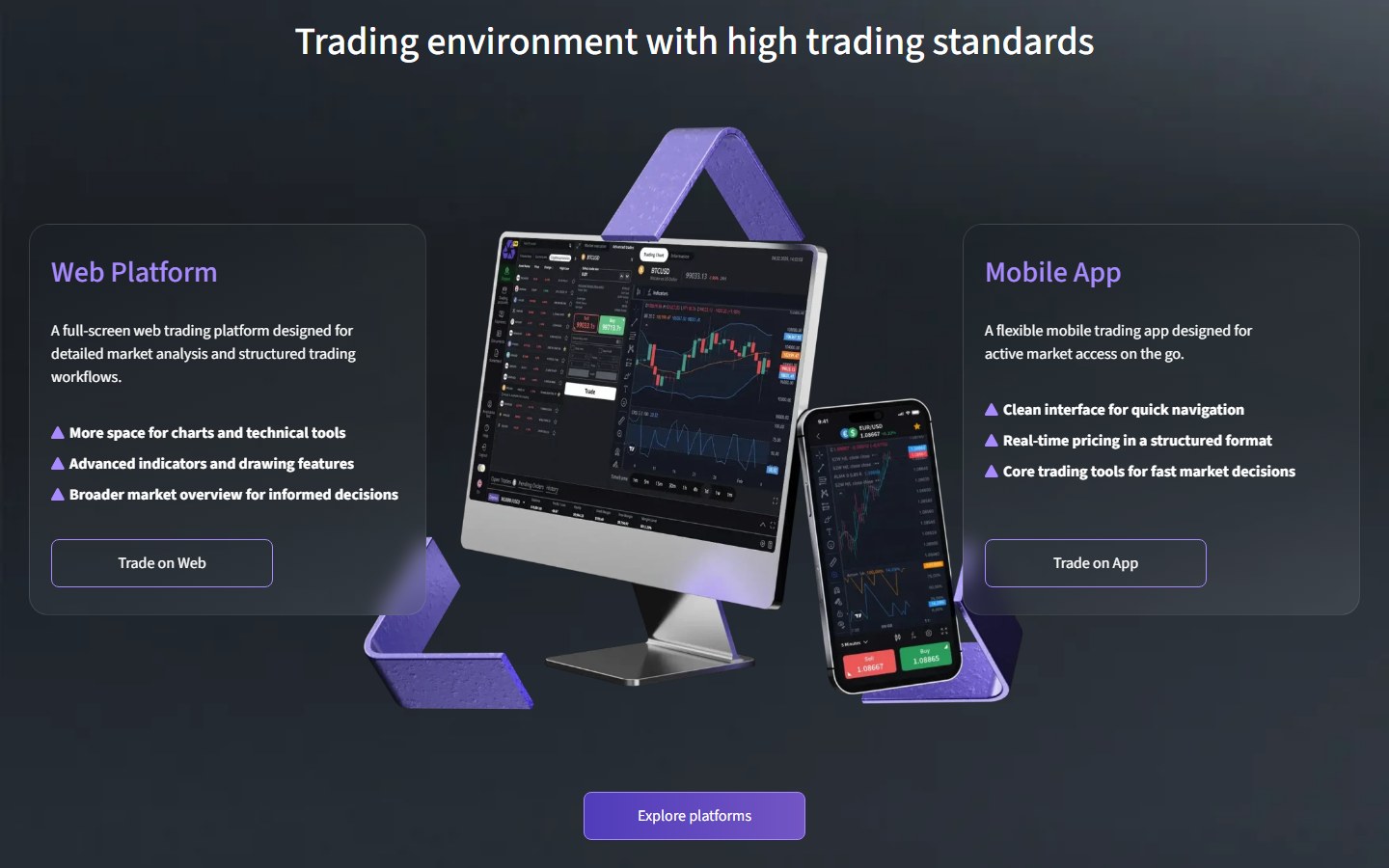
No MetaTrader here. HighMarkets built its own pair instead: a Web Platform that opens in the browser with nothing to install, and a Mobile App. Both draw their charts from TradingView, and that’s the part worth paying attention to.
Most people who trade retail already use TradingView somewhere in their day, usually in a second tab while the order sits in a third. Here the indicators, the drawing tools and the timeframes are the ones you know, and the order goes in the same place you drew the trendline. Less tab-hopping. It sounds like a small thing until you’ve spent a year doing it the other way.
The browser version is where the real work happens. Charts get the space, the indicator list is full, and you can see more of the market at once. The app is deliberately thinner: live prices, your open positions, Stop-Loss and Take-Profit, enough to manage a trade from a train. Both stay in sync, according to the help centre.
Who loses out? Anyone running expert advisors, the automated strategies people write for MetaTrader. Those don’t come across. I’ve used both platforms for years and going back to MT4 now feels like opening a laptop from 2009, but that’s taste, not a verdict.
The other thing about a proprietary platform is that your setup belongs to the broker. Leave, and the templates, the saved layouts and the indicator settings stay behind. TradingView softens that, since the charting half is portable knowledge. The rest isn’t.
One blank space we couldn’t fill: execution quality. Nothing is published on slippage, average fill times or rejected orders. That’s normal at this end of the market and it’s still a gap. Trade the first few news releases small and watch what actually happens to your fills.
Markets and instruments
Everything is a CFD (contract for difference), so you’re trading the price move and never owning the thing itself. Six groups sit on the Markets page: Forex, Metals, Crypto, Stocks, Commodities and Indices. The contract specification quietly adds a seventh, ETFs.
We went through that PDF and counted. The figures below are approximate, because a few rows wrap across pages, but they’re close enough to show the shape of the offer.
| CFD category | Approx. number | Examples |
|---|---|---|
| Forex | 40 | EUR/USD, GBP/JPY, EUR/PLN, USD/TRY |
| Metals | 5 | Gold, silver, platinum, palladium |
| Indices | 14 | Nasdaq 100, DAX, FTSE 100, FTSE MIB, ASX SPI 200 |
| Commodities | 11 | Crude oil, natural gas, coffee, cocoa, sugar, copper |
| Crypto | 18 | Bitcoin, Ethereum, Cardano, Polkadot, Dogecoin |
| Share CFDs | about 240 | US, UK, EU, Middle East, Latin America |
| ETF CFDs | 19 | Listed in the contract specification |
The share CFDs are the surprise. Apple, Tesla, Nvidia and the rest of the US crowd are there, of course. But so are CFDs on roughly fifty Gulf companies: Saudi Aramco, Emaar Properties, Qatar National Bank, Dubai Islamic Bank, even Salik, the Dubai toll operator. Very few brokers this size bother with those markets.
It also answers the question of who the broker is really for. Two languages on the site, English and Arabic. Phone numbers running from Kuwait to Kuala Lumpur. CFDs on Gulf shares in the instrument list. Europe and North America aren’t the audience, and the restricted-country list says so outright.
The ETF CFDs are odd, though. The Markets page doesn’t mention them at all, yet nineteen of them sit in the PDF. Either the website is behind the offer or the PDF is ahead of it. We wouldn’t build a plan around them without asking support first.
Something else caught our eye in the Trading Holidays section. In late August it listed Mawlid al-Nabi, with CFDs on Kuwaiti shares closed on one day and those on Emirati shares on another. Anyone can copy a list of Western bank holidays off the internet. Keeping a Gulf calendar straight takes someone who knows those markets. Anyway.
Minimum order size is 0.01 lots on everything we checked, with 100 lots at the top end. You can start genuinely small.
Account types
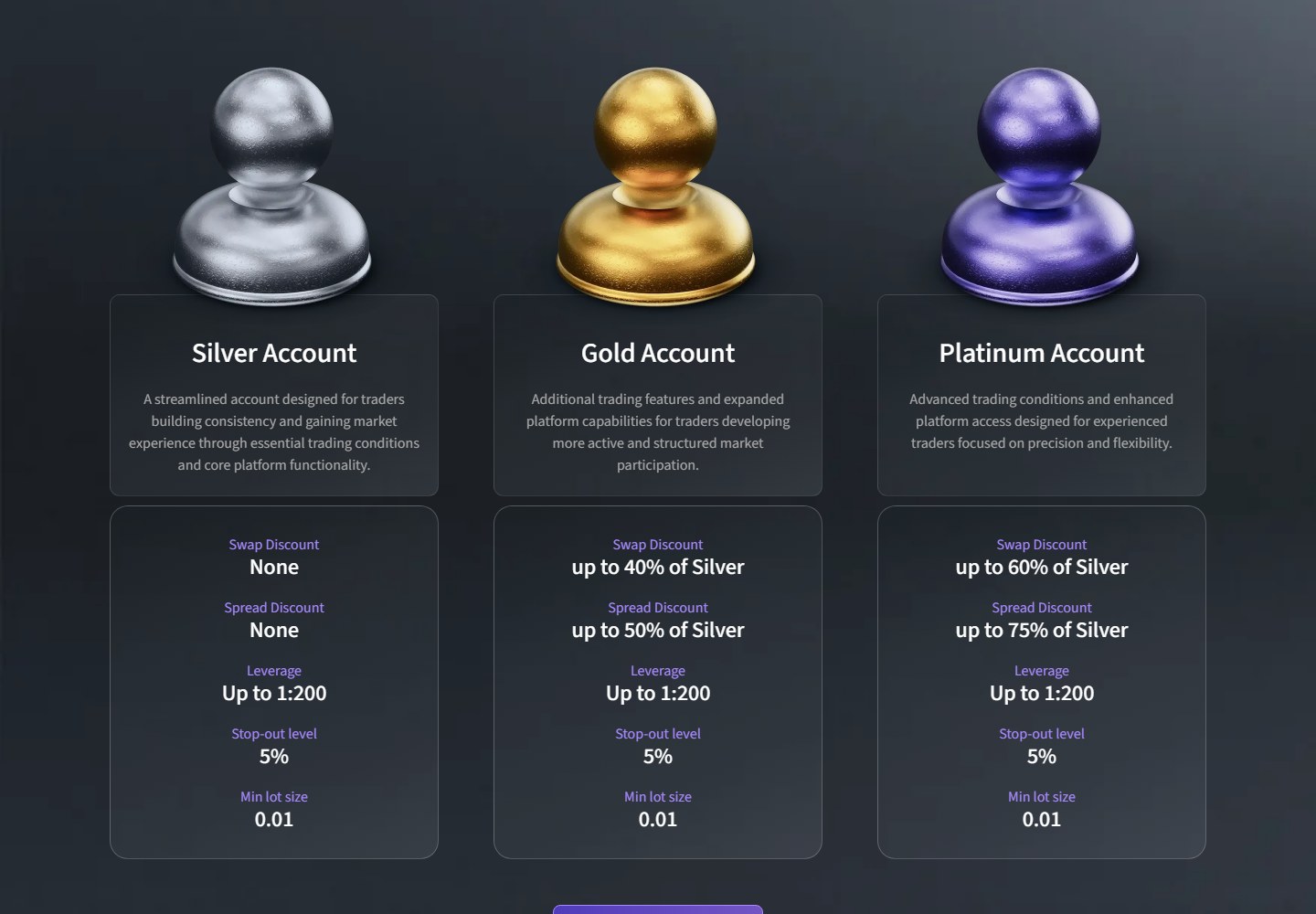
Three tiers: Silver Account, Gold Account, Platinum Account. Same platform, same instruments, same leverage ceiling on all of them. What moves is the price of trading.
| Silver | Gold | Platinum | |
|---|---|---|---|
| Spread discount | None | Up to 50% of Silver | Up to 75% of Silver |
| Swap discount | None | Up to 40% of Silver | Up to 60% of Silver |
| Leverage | Up to 1:200 | Up to 1:200 | Up to 1:200 |
| Stop-out level | 5% | 5% | 5% |
| Minimum lot size | 0.01 | 0.01 | 0.01 |
Simple enough to follow, and three quarters off the spread is a real difference if you trade often. What the Accounts page never says is how you get there. No deposit thresholds, no volume targets, nothing. Support will have to tell you.
And here’s where we’d push back harder. Every discount is quoted against Silver, but Silver’s own spread isn’t published. Three quarters off an unknown number is still an unknown number. Until there’s a spread table on the site, the only way to compare this broker against a European one is to sit on the demo and watch the quotes for a few days.
That 1:200 needs a footnote too. The contract specification splits margin between retail and professional clients, and retail rates are a good deal higher: 3.33% on the major pairs, so roughly 1:30. Crypto CFDs sit at 10%, single share CFDs at 20%. Most private clients will therefore trade at far less leverage than the headline suggests, which honestly suits us fine.
Margin call comes at 75%, stop-out at 5% of the margin level. Five per cent is low. It leaves a position plenty of breathing room, and it also lets an account bleed a long way before anything happens on its own.
The stop-out is the moment the platform stops waiting and closes your trades for you. It’s measured as margin level: your equity divided by the margin the open positions tie up. At HighMarkets that trigger sits at 5%. Get there and the system starts shutting positions down so the account doesn’t go negative.
There’s an Islamic Account as well, for clients who can’t pay or receive interest. Read the clause before you rely on it. The client agreement grants swap-free status for seven calendar days, extended only if the broker agrees in writing. After that, swaps are charged like everyone else’s. If you hold trades for weeks, that changes the maths completely.
Fees and trading costs
The spread does the earning here. We found no per-lot commission anywhere, not on the site, not in the agreement, not in the specification. Spreads are variable. And they’re not published, not even for EUR/USD, which is the single biggest gap in an otherwise open set of documents.
Overnight swaps are at least in the PDF, tier by tier. On most instruments they’re negative in both directions, long and short, so holding costs money whichever way you’re positioned. Gold and Platinum knock 40% and 60% off that.
Charging both sides is normal in this industry and it still nags at us. A short in a high-interest currency ought to pay you something. The financing spread eats it instead. Treat overnight holding as a cost, never as income.
Deposits don’t cost anything on the broker’s side. Withdrawals get processed within three business days, and whatever fee appears comes from your bank or the payment provider.
Then there’s a fee that has nothing to do with trading at all. Buried in the client agreement is an examination of application fee of 50 USD, EUR or GBP for new clients. The same clause says it’s applied at the company’s discretion and may not be charged. Fine, but put it on the list of questions before your first deposit.
Currency is the other quiet cost. Accounts run in USD, EUR or GBP; anything else gets converted on the day, at your expense. Withdrawals through a payment provider work in EUR and USD only.
Match your account currency to the card or bank account you’ll be sending money from. A conversion on the way in and another on the way out can cost more than the spread on your first few trades, and nobody sends you an invoice for it.
Bonuses
Nothing on the homepage pushes a bonus, which we noticed and liked. The Bonus Terms & Conditions still sit in the legal section, because offers get announced from time to time.
The maths is the usual maths. Every 1,000 USD of bonus carries a requirement of 300 standard lots, and only closed forex trades count. Ask to withdraw before you’ve got there and the company can wipe the profits earned since the bonus landed.
Three hundred lots is a serious amount of turnover. Unless you’re already trading at that pace, take the account without the bonus and keep your money uncomplicated.
Deposits and withdrawals
The payment icons on the site show Visa, Visa Debit, Mastercard, Apple Pay and Google Pay. The help centre adds bank transfers and some e-wallets, depending where you live.
- Log in to the Client Area and open the Deposit section.
- Pick the method, type the amount, confirm.
- Cards and e-wallets usually land instantly. Bank transfers take a few days.
- Withdrawals go through the same Client Area and normally return by the route the money came in.
Verification has to be finished before any withdrawal, and the payment method must be in your own name. Both are standard, and both catch people out when they leave the paperwork until the day they want their money.
Opening an account
The form is short: name, email, phone, password. The tick box for newsletters and the one agreeing to a call about your registration are separate, and you can leave them both empty. Small thing, quietly appreciated.
Then comes verification. A passport or ID card, plus something recent with your address on it, a utility bill or a bank statement. Sometimes a selfie or proof of where the money came from. The help centre says 24 to 48 hours, and until it’s done you can neither trade live nor withdraw.
There’s a demo with virtual money, and with a platform nobody else uses, that’s where we’d start. Give it a few days. You’ll know soon enough whether the order ticket and the TradingView setup suit the way you trade.
Customer support
Chat, email and phone, 24 hours a day, five days a week. Chat should answer straight away; email replies are promised within a business day, and the contact form admits it can stretch to 48 hours when things are busy.
We should be honest about what that paragraph is worth. We haven’t held a live account here, so we can’t tell you how fast anyone picks up at four o’clock on a busy Friday. What we can say is that the promises are specific and fairly modest, and in our experience that beats a pledge of instant help around the clock.
Sixteen local numbers are listed, from the UAE and Saudi Arabia through Singapore and Malaysia to a UK line. A footnote underneath makes clear the company has no office in any of those countries and the numbers exist for the convenience of existing clients.
The Help Center turned out better than we expected. Getting Started, Account & Payments, Trading on HighMarkets, Risk Management, Platform & Technology, Technical Support, Trading Fundamentals. Short answers, no sales talk, and the parts on margin, margin calls and stop orders are written for someone who’s genuinely new. They don’t soften what leverage can do to an account either.
Regulation and safety
Behind the brand is DXA SEYCHELLES LIMITED, registered in Seychelles under number 8438281-1 and holding securities dealer licence SD218 from the Financial Services Authority.
The FSA is a real supervisor. There’s a licensing process, reporting duties, a complaints channel. It’s also offshore, and the gap matters: capital requirements are a fraction of what the FCA or CySEC demand, and there’s no fund standing behind client money the way the FSCS does. If the company went under, nobody would be writing cheques to its clients.
Things that count in its favour:
- Seven documents on the Legal page, from the Client Service Agreement and Risk Disclosure to the Bonus Terms and the Contract Specification. The main ones carry an August 2026 date.
- The complaints procedure sets out steps and deadlines, with the FSA named as the escalation route if the answer doesn’t satisfy you.
- Announcements record even a change of the licensed securities dealer representative, with the effective date. Offshore brokers rarely bother.
- The excluded countries are stated plainly rather than buried.
One clause deserves attention before you sign anything. Under the agreement, HighMarkets is the counterparty to your trades. That’s the market maker model, common enough among CFD brokers, but it does mean your interests and theirs are not automatically pointing the same way.
British readers, note this: the company isn’t FCA authorised. The UK isn’t on the restricted list, so you can open an account, but you’d be a client of an offshore firm, with no Ombudsman and no FSCS behind you.
Our own habit with offshore brokers has nothing to do with this one in particular. Keep only your working capital on the account. Take profits off on a schedule rather than letting a balance build. Get verified in the first week so no withdrawal ever waits on a document. Do those and the distance between a tier-1 licence and this one shrinks a long way.
Our verdict
For a young offshore broker, HighMarkets left a better impression than we expected. TradingView in the browser and the app, a site that loads fast and doesn’t shout, a help centre that treats beginners as adults. And the instrument list runs deeper than the homepage lets on.
The tiers are honest in structure, the documents are complete and dated, and nobody is waving a deposit bonus in your face on arrival. At this end of the market, that combination is rarer than it should be.
The weak spots live in the small print. Offshore licence. No published spreads. Swaps against you in both directions. None of that rules the broker out, but it should shape how you use the account.
If we could change one thing, it’d be the spreads. Publish them. Everything else here is laid out openly, right down to the margin rates, which makes the silence around the single biggest cost of trading stick out.
Start on the demo and watch the spreads on the instruments you actually trade, at the hours you actually trade them. Then ask support two questions before you fund anything: what the minimum deposit is, and what it takes to reach Gold or Platinum.
Who’s it for? Someone outside the EU and North America who likes TradingView, trades often enough to care about tier discounts, and wants CFDs on Gulf shares next to the usual forex and index CFDs. If you’re buying and holding for years, this isn’t your broker. Then again, no CFD broker is.
74-89% of retail investor accounts lose money when trading CFDs with this provider. You should consider whether you can afford to take the high risk of losing your money.
FAQ
Is HighMarkets regulated?
Yes, by the Financial Services Authority of Seychelles, licence number SD218, held by DXA SEYCHELLES LIMITED. It’s an offshore licence, so there’s no compensation scheme of the FSCS kind behind it.
Is HighMarkets legit?
The company is registered, licensed, publishes its legal documents and runs a complaints procedure that escalates to the regulator. So yes, it’s a licensed broker. Just understand that offshore supervision protects you less than the FCA or CySEC would.
What is the minimum deposit at HighMarkets?
It isn’t published anywhere on the site. Ask support before you open the account.
Does HighMarkets accept clients from the EU or the UK?
Not from the European Union, the USA or Canada. The UK isn’t on the restricted list, though the company holds no FCA authorisation.
Does HighMarkets offer MetaTrader 4 or MetaTrader 5?
No. You trade on the broker’s own Web Platform or Mobile App, both using TradingView charts.
What leverage does HighMarkets offer?
Up to 1:200 on all three tiers, though the contract specification sets retail margin higher on many instruments, around 1:30 on the major currency pairs.
Does HighMarkets charge commissions?
We found no per-lot commission in the documents or on the website. The broker earns from the spread, and anything held overnight also pays a swap.
Does HighMarkets have a demo account?
Yes, funded with virtual money, and it opens the full platform so you can test it before depositing.
How long does a withdrawal take at HighMarkets?
The broker processes requests within three business days. After that it’s down to your bank or payment provider.
I invested $5000 a month ago. For now my profit is only 10% and I keep trading with HighMarkets expecting higher result. In general I like how the platform work and my account conditions